What Is DeepSeek Harness? The Modular AI Agent Framework
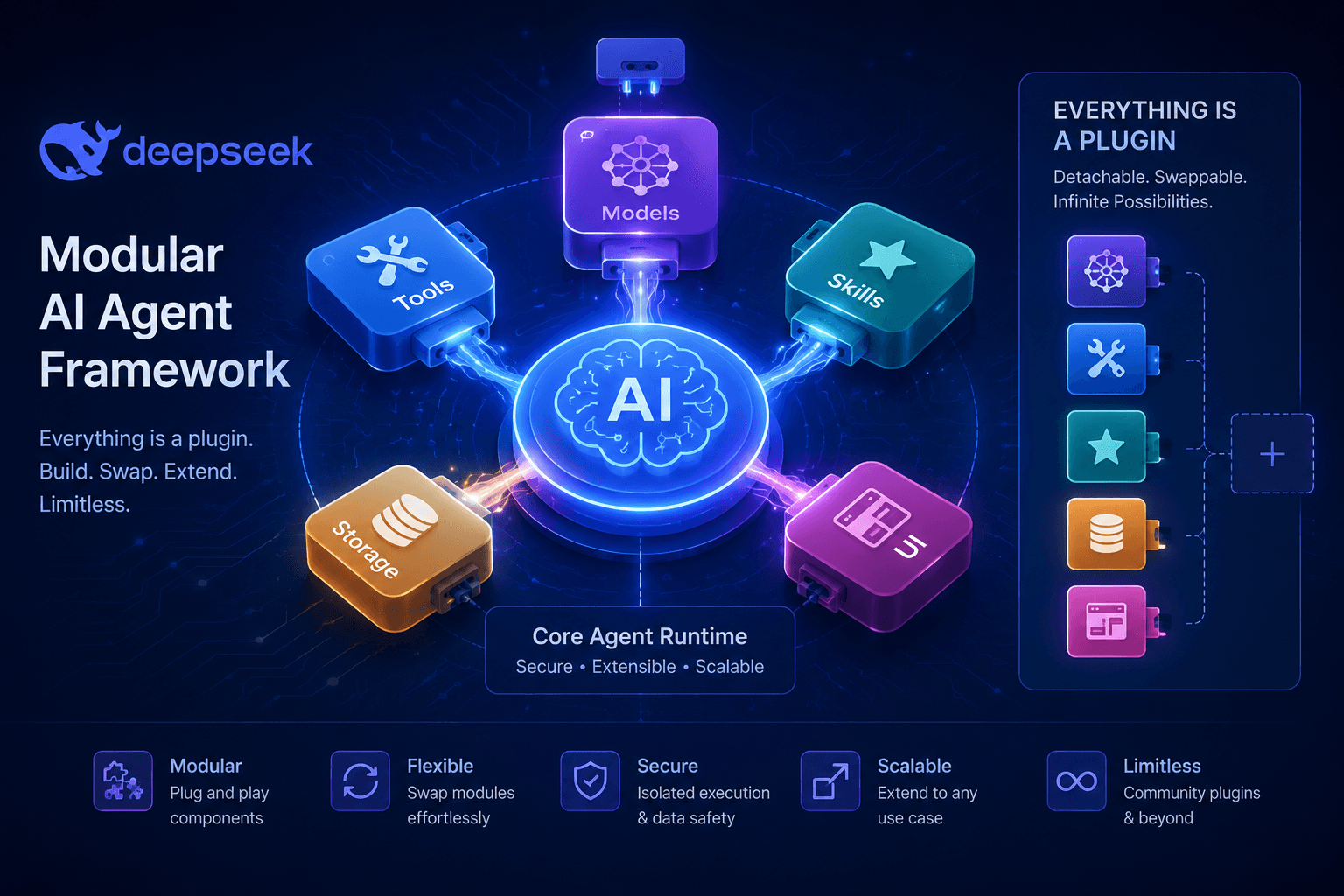
DeepSeek Harness (dsh) is an open-source AI agent framework developed by DeepSeek AI. Built on the Cordis kernel, it uses an "everything-is-a-plugin" architecture. This allows developers to compose, customize, and fully trace agent capabilities such as models, tools, sandboxes, and UIs through configuration, without modifying the core source code.
If you are building agentic workflows and struggling with rigid, monolithic frameworks that are hard to debug or extend, DeepSeek Harness provides a modular, transparent alternative designed specifically for real-world agent deployment and evaluation.
Core Features of DeepSeek Harness
DeepSeek Harness solves the common developer frustration of "black box" agent behavior by prioritizing modularity and observability. Its standout capabilities include:
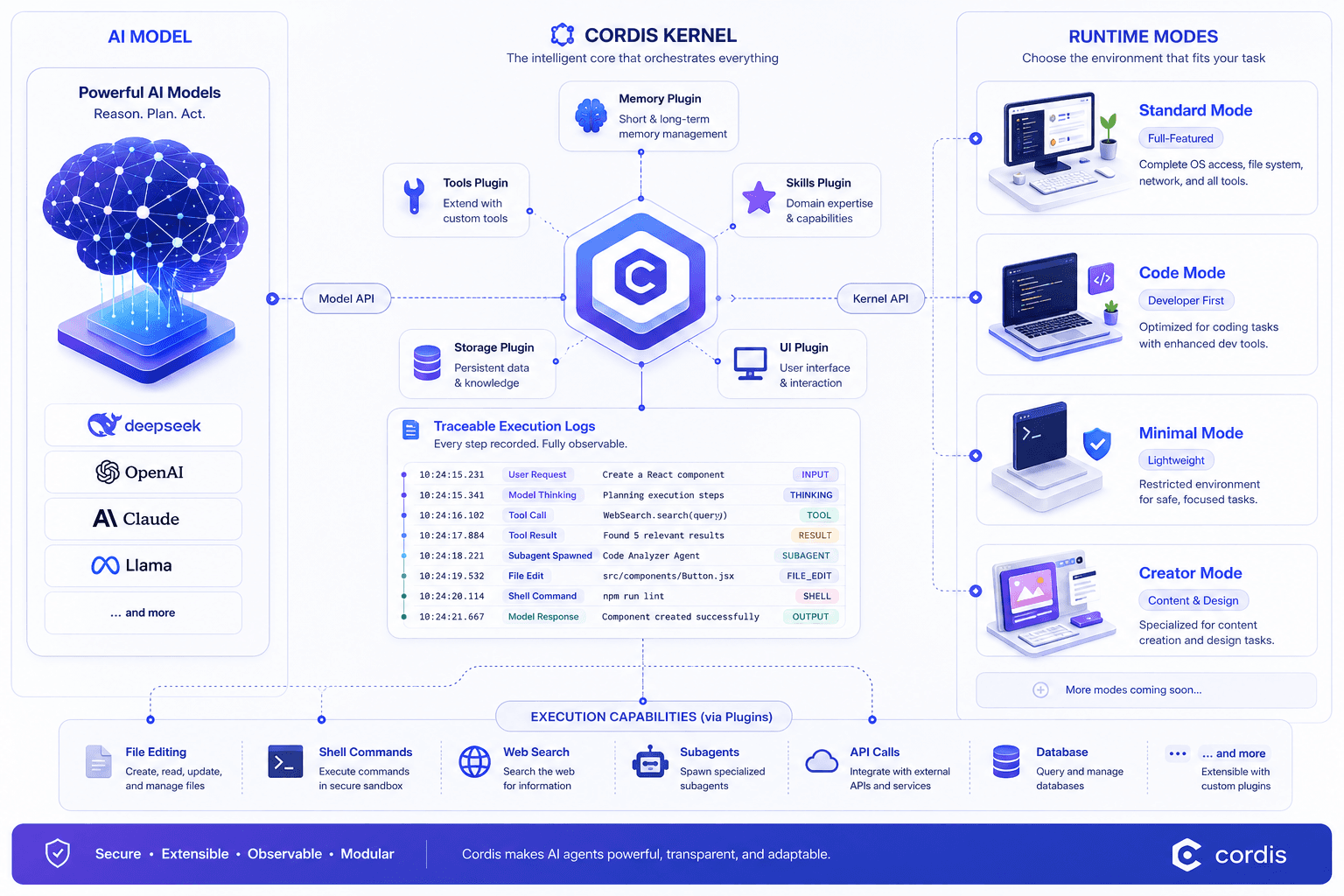
- Everything Is a Plugin: Powered by the Cordis kernel, every agent capability (models, tools, skills, sessions, storage, loops, and scheduling) is a swappable plugin. You can extend or replace features via configuration files without touching the underlying codebase.
- Fully Traceable Runs: Every interaction is recorded in an append-only session log. This includes system prompts, reasoning steps, tool calls, subagent scheduling, and context injections. Developers can inspect, resume, fork, search, and replay any part of the agent’s trajectory.
- Multiple Runtime Modes: The framework adapts to your specific use case:
- Standard Mode: A full-featured coding agent with file editing, shell access, web search, planning, and subagents.
- Code Mode: Exposes tools through a Code Mode SDK, allowing the model to orchestrate multi-step operations within a single TypeScript program.
- Minimal Mode: Strips the environment down to a persistent bash shell and file editor, ideal for clean, controlled model benchmarking.
- Creator Mode: Designed for building custom agent presets, offering runtime inspection and in-memory plugin experimentation.
How to Install and Run DeepSeek Harness
DeepSeek Harness is currently in developer preview, meaning it is iterating rapidly and may introduce compatibility-breaking changes. It requires Node.js and pnpm for source installations.
Option 1: Quick Start via npm (Recommended for Testing)
If you have Node.js installed, you can launch the local Web UI instantly without cloning the repository:
bash
This starts the Web UI at http://127.0.0.1:3080 and opens it in your default browser. Add --no-open to run the server silently.
Option 2: Run from Source (Recommended for Development)
For deeper customization or to contribute to the project, clone the official repository:
bash
Common Misconceptions About DeepSeek Harness
When searching for "DeepSeek Harness," developers sometimes confuse it with other tools. Clarifying these points saves time and prevents setup errors:
- It is not a CI/CD tool: Despite the name "Harness," this has no relation to popular DevOps CI/CD platforms. It is strictly an agent runtime and development framework.
- It is not a model training library: DeepSeek Harness does not fine-tune or train LLMs. It is designed to orchestrate existing models, giving them tools and memory to act as autonomous agents.
- It is not just an evaluation script: While it includes a "Minimal Mode" for benchmarking, its primary purpose is building and tracing functional, multi-step agentic workflows, going far beyond simple prompt evaluation.
Frequently Asked Questions
What is DeepSeek Harness primarily used for?
It is used to build, configure, and debug autonomous AI agents. Developers use it to give language models access to tools (like file systems or web search), manage multi-step reasoning, and maintain fully traceable session logs.
Is DeepSeek Harness free and open-source?
Yes. DeepSeek Harness is completely open-source under the DeepSeek AI organization. You can view the source code, contribute, and deploy it locally without licensing fees.
How does DeepSeek Harness differ from lm-evaluation-harness?
The lm-evaluation-harness (by EleutherAI) is designed primarily for benchmarking model accuracy on static datasets. DeepSeek Harness is an agentic runtime focused on dynamic, multi-turn tool use, plugin composability, and real-world task execution.
Can I use models other than DeepSeek models in DeepSeek Harness?
Yes. Because "everything is a plugin," the framework is designed to be model-agnostic. You can configure it to route requests to different model providers or local endpoints via its plugin system.
Conclusion
DeepSeek Harness represents a significant step forward in making AI agent development transparent and modular. By treating every capability as a plugin and guaranteeing fully traceable execution logs, it removes the guesswork from building complex, multi-step agentic workflows.
If you are ready to experiment, start with the quick npx command to explore the Web UI, and refer to the official documentation for advanced plugin configuration.