
BitChat by Permissionless Tech: Decentralized Offline Mesh Chat App
Published on Recently
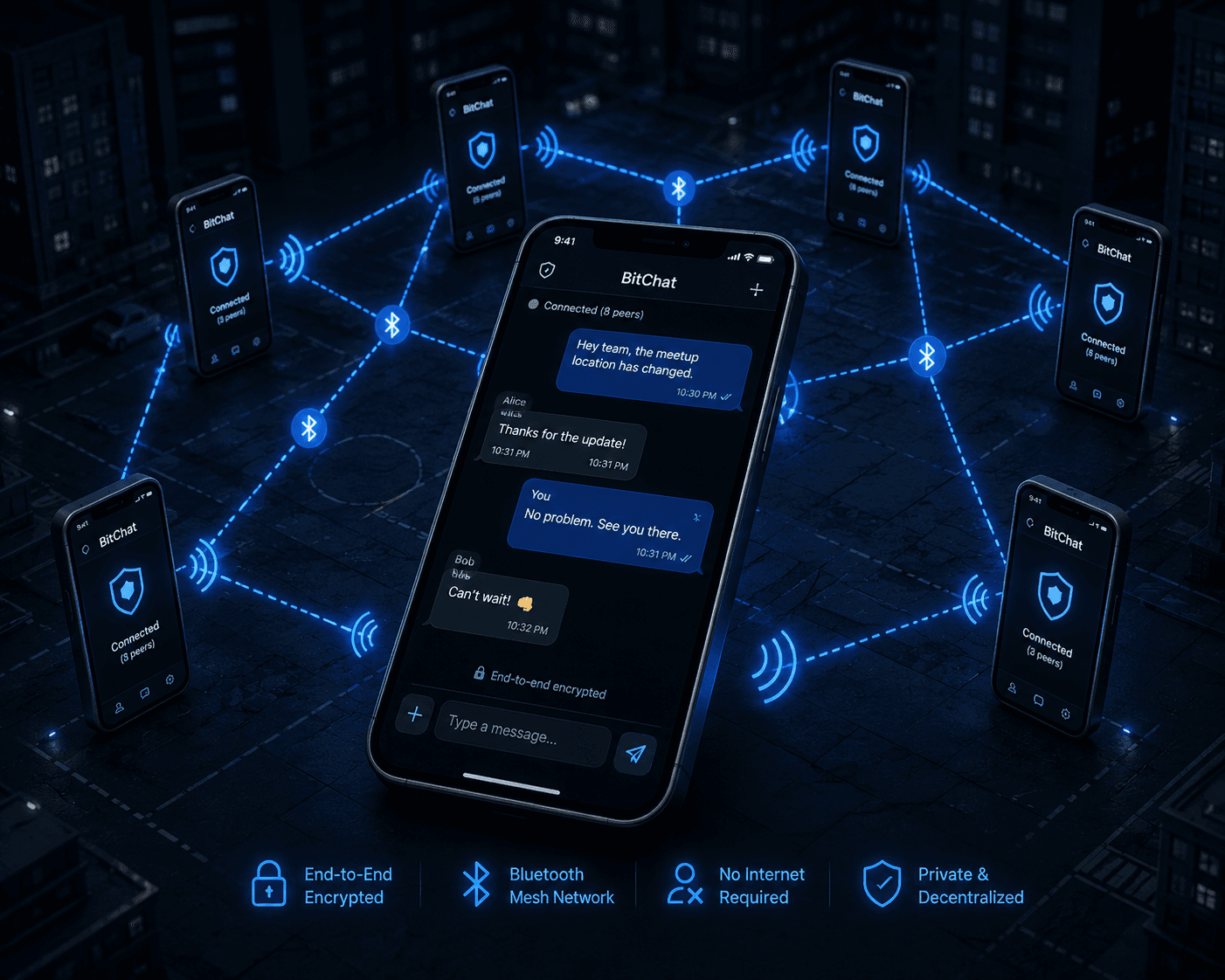
What Is BitChat? The Decentralized Offline Messaging App
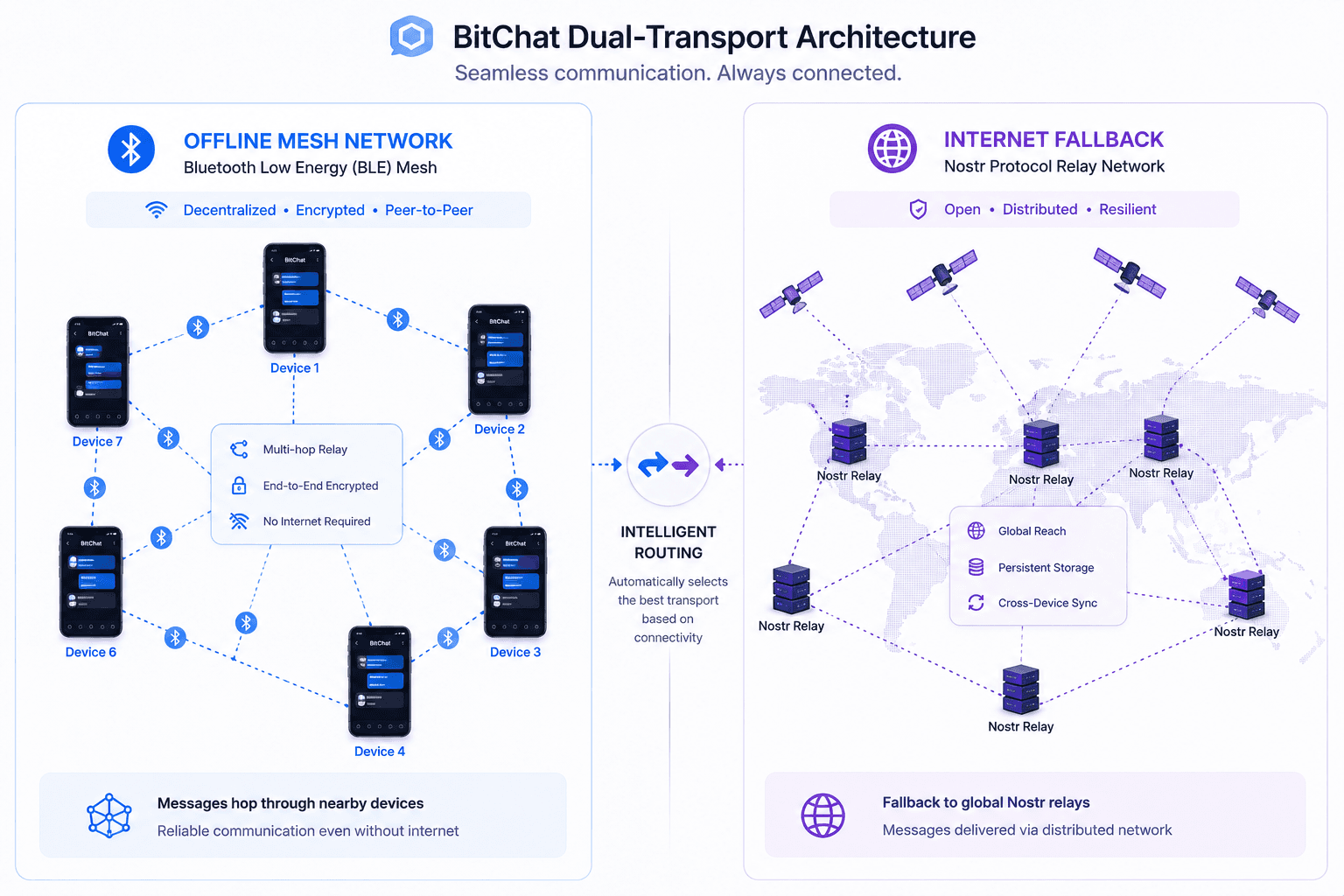
BitChat is a decentralized, peer-to-peer messaging application developed by Permissionless Tech. Unlike traditional messaging platforms, it requires no central servers, phone numbers, or user accounts. Instead, it utilizes a dual-transport architecture: Bluetooth Low Energy (BLE) mesh networks for offline, local communication, and the Nostr protocol for global, internet-based messaging fallback.
Who Is BitChat For?
If you are searching for a resilient communication tool that works during internet outages, protests, or in remote areas, BitChat provides a practical, open-source alternative to Big Tech messaging apps.
Based on real-world use cases, the primary audiences include:
- Privacy Advocates: Individuals seeking alternatives to data-harvesting platforms that require phone numbers or cloud backups.
- Activists and Journalists: Those operating in regions with internet shutdowns, network throttling, or heavy digital surveillance.
- Outdoor Enthusiasts and Preppers: People who need reliable, device-to-device communication in remote areas without cellular service.
- Developers and Technologists: Professionals interested in auditing, modifying, or building upon public-domain decentralized networking tools.
How BitChat Works: Dual-Transport Architecture
BitChat intelligently routes messages based on environmental availability, ensuring you stay connected across different scenarios.
Bluetooth Mesh Network (Offline)
- Local Communication: Devices communicate directly via Bluetooth Low Energy (BLE) when within physical proximity.
- Multi-hop Relay: Messages can automatically route through nearby devices (up to 7 hops), extending the network’s reach far beyond a single device's standard Bluetooth range.
- Zero Internet Required: The mesh operates entirely independently of cellular data or Wi-Fi networks.
- Noise Protocol Encryption: Live sessions use the Noise Protocol Framework for end-to-end encryption with forward secrecy.
Nostr Protocol (Internet Fallback)
- Global Reach: When Bluetooth is unavailable, BitChat can fall back to the Nostr Protocol to connect with users worldwide via decentralized internet relays.
- Location-Based Channels: Users can join geographic chat rooms using geohash coordinates. Precision varies from 7 characters (city block level) to 2 characters (country/large region), enabling hyper-local coordination without exposing exact GPS data to a central authority.
- Proprietary Private Envelopes: Direct messages over Nostr use BitChat’s custom XChaCha20-Poly1305 encryption, ensuring payloads are only readable by verified BitChat clients.
Key Features and Privacy Realities
While BitChat offers robust privacy features, it is important to separate marketing hype from technical reality to use the tool safely and effectively.
Standout Features
- No Accounts or Phone Numbers: Eliminates the primary vector for identity tracking and SIM-swapping attacks.
- IRC-Style Commands: Familiar text-based commands (like /msg, /slap, or /who) provide a lightweight, power-user-friendly interface.
- Emergency Wipe: A simple triple-tap gesture instantly clears all local data a critical feature for high-risk situations where device seizure is a threat.
- Public Domain License: The source code is released into the public domain, allowing unrestricted auditing, modification, and distribution.
Common Myth vs. Reality
Myth: "Offline mesh apps provide complete, untraceable anonymity."
Reality: BitChat uses a persistent per-device identifier derived from your identity key to route messages effectively. While it prevents casual tracking and requires no phone number, a sophisticated nearby radio observer could potentially correlate metadata over time. Furthermore, store-and-forward messages on the Nostr fallback do not have the same forward secrecy as live Bluetooth sessions. Always review the official BitChat Technical Whitepaper for detailed threat modeling.
How to Safely Download and Use BitChat
Because decentralized apps can be spoofed, obtaining a verified copy is crucial for your security. Malicious mirrors often appear during internet blackouts or after repository takedowns.
- Official App Stores: The safest method for most users is to download "bitchat mesh" from the Apple App Store or "bitchat" from the Google Play Store.
- Build from Source: Advanced users can verify the code and compile it themselves. The complete, up-to-date source code is available on the BitChat iOS/macOS GitHub Repository and the BitChat Android GitHub Repository.
- Verify Your Build: If you must use a third-party APK or mirror, consult the project’s verification documentation to check the release against the official SHA-256 hash manifest. Never install unverified compiled builds during network instability.
Frequently Asked Questions
1. Does BitChat work without an internet connection?
Yes. BitChat’s primary function is its Bluetooth Low Energy (BLE) mesh network, which allows devices to discover each other and relay messages locally without any cellular data or Wi-Fi.
2. Is BitChat the same as other decentralized apps like Briar or Bridgefy?
While they share similar goals, BitChat is unique in its dual-transport design. It combines local Bluetooth mesh networking with a Nostr protocol fallback for global reach. Apps like Briar rely on Tor/Bluetooth/Wi-Fi, while Bridgefy is primarily offline-only without a built-in global decentralized protocol.
3. Can I use BitChat to message someone in another country?
Yes, but only if both devices have an active internet connection. In this scenario, BitChat uses the Nostr protocol to route the message through global relays. The offline Bluetooth mesh is strictly limited to physical, multi-hop proximity.
4. Is my message history saved on a central server?
No. BitChat has no central servers. Messages are either relayed live through nearby devices or temporarily queued on your device until a connection is established. Accepted media is stored locally on your device under your operating system's native data-protection class.
Conclusion
BitChat by Permissionless Tech represents a significant step forward in resilient, privacy-focused communication. By combining offline Bluetooth mesh networking with a Nostr internet fallback, it offers a practical, censorship-resistant solution for users who need to stay connected without relying on centralized infrastructure. However, like any security tool, its effectiveness depends on understanding its limitations. For high-stakes privacy, always download the app from official sources, verify your builds, and familiarize yourself with its technical documentation.